
This time both stories are about timing — how often you take something, and what may be coming later. One is a levodopa product, newly approved in the European Union, that cut daily doses from five to three while lengthening the time symptoms stayed controlled. The other is a study that read gene activity in a blood sample and connected it to what happened years afterwards.
Five doses a day down to three — an extended-release levodopa has been approved in the EU
🔍 How this came about
The European Commission has approved Hopledo, a levodopa/carbidopa product already sold in the United States under the name Crexont (development name IPX203). It is for adults who still have motor fluctuationsThe cycle between 'on' periods, when medication is controlling symptoms well, and 'off' periods, when the benefit fades and symptoms return. Early on it shows up as predictable wearing off before the next dose; later it can arrive suddenly and irregularly.Learn more despite treatment.
What is new here is not the ingredient but the build. A single capsule holds both fast-dissolving immediate-release granules and slow-dissolving extended-releaseA formulation built to let the medication out slowly rather than all at once. It lasts longer but takes longer to start working. Splitting or chewing it breaks that structure and releases the whole dose at once, so it must never be cut on your own.Learn more beads. That is what lets it start working quickly and still last.
The numbers behind the approval come from the phase 3The stage that gathers more safety and efficacy information by comparing across varied groups and doses. Enrolment is large, and this stage generally has to be cleared before a regulator will review the product for approval.Learn more RISE-PD trial (630 participants). Compared with immediate-release levodopa/carbidopa, good on time went up and off time went down. And the number of doses fell rather than rose — an average of three a day on Hopledo against five on the immediate-release form. A nine-month extension study found both the symptom control and the dosing frequency held.
Zambon, which holds the rights to sell it in Europe, says it will begin rolling the product out across European markets from October.
✅ If you live with Parkinson’s
This does not change anything for you today. But there is one thing worth taking from it — “the benefit does not last as long as it used to” and “I have to take it so often” are things that can be worked on, not just endured. Cutting five doses a day down to three was possible in an actual trial.
If your current medication keeps fading before the next dose is due, that belongs in your next appointment rather than in the background of your day. Extended-release forms of levodopa exist in many places, and some people are prescribed a different formulation only at bedtime, when overnight stiffness is the problem.
🙋 If you are a care partner
The most useful preparation for news like this is a record. Deciding whether to change the formulation or the number of doses belongs to the care team, but the raw material for that decision can only be gathered at home.
Even a few days of these three makes the conversation a different one.
- How many minutes until the medication takes effect — thirty, or an hour
- How early it fades before the next dose — something like “an hour before the next one, the stiffness is back”
- Which part of the day is worst — before the first dose, mid-afternoon, or at night
“The medication doesn’t seem to last as long lately” is much less useful than “the lunchtime dose is gone in two hours.”
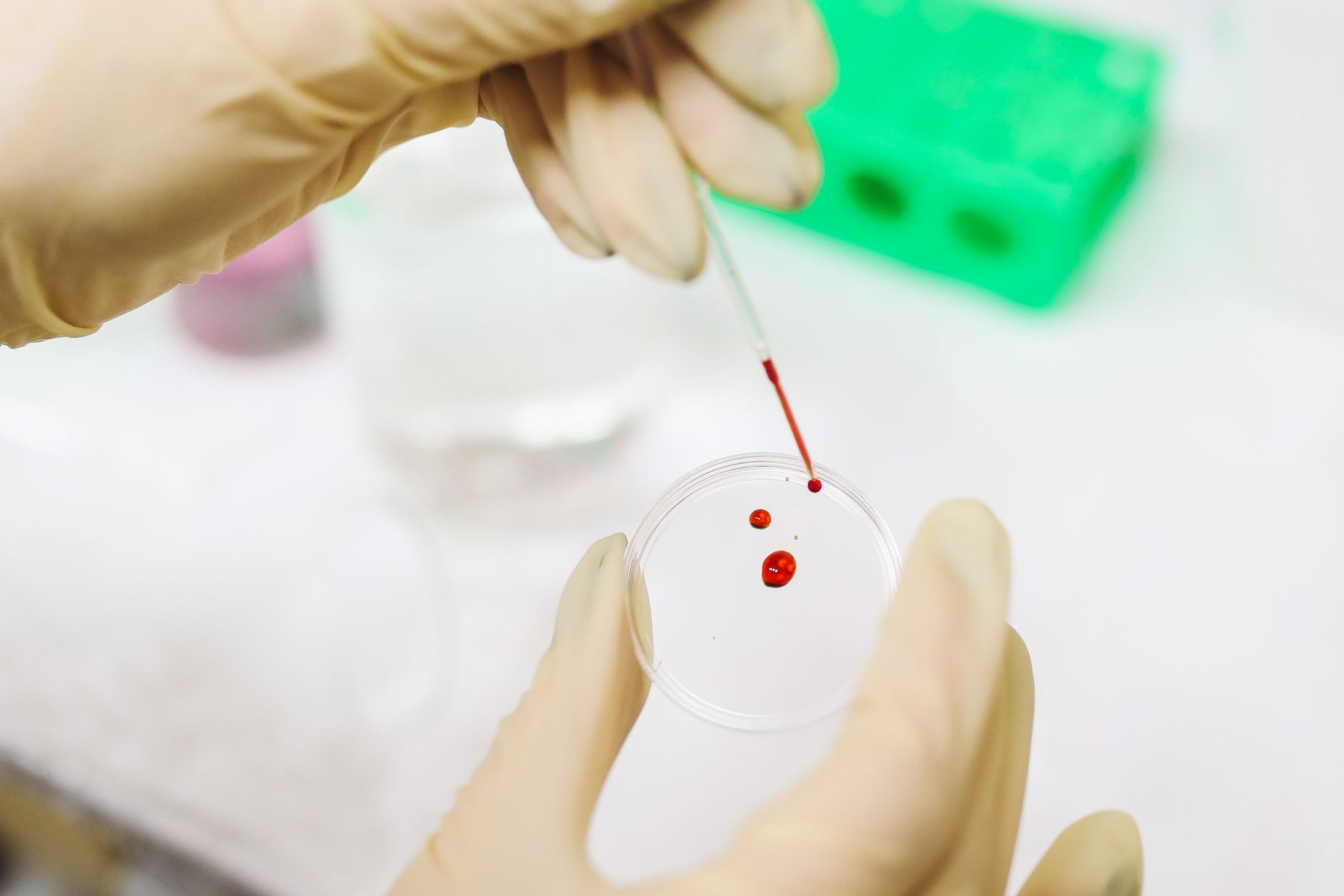
A blood sample, and an estimate of cognitive decline and freezing of gait years later
🔍 How this came about
Researchers in South Korea analysed blood from 541 people with Parkinson’s and 180 healthy controls, publishing in the journal npj Parkinson’s Disease. The samples came from PPMI, a large long-running observational dataset based in the United States.
What they looked at was not gene variants but gene activity. Two people can carry the same genes while those genes are switched on to different degrees, and that degree can be read in blood. Rather than examining 29,000 genes one by one, the team grouped them into bundles that switch on and off together. Two bundles turned out to be strongly tied to Parkinson’s, and both were crowded with genes involved in inflammation and immune cells.
From those two bundles they gave each person a score between 0 and 1, where a higher score means further from the pattern seen in healthy controls. Then they looked at what happened over a median of eight years.
Even after accounting for age, disease duration and other factors, a higher score came with a 7.3-fold higher risk of cognitive impairment and a 3.4-fold higher risk of freezing of gait.
The most interesting part, though, is what it did not connect to. The score had no relationship at all with wearing off or dyskinesiaInvoluntary writhing or swaying movements that can develop after long-term levodopa use, as the brain's response to the drug changes. They tend to appear when the medication is at its strongest — during 'on' periods.Learn more. Those two come from how the body responds to dopamine medication. Cognitive decline and freezing of gait are on the other side of that line — the side dopamine alone does not explain — and the inflammation signal in blood lined up with exactly that side.
✅ If you live with Parkinson’s
A “7.3-fold” figure can be alarming, so here is the situation stated plainly: this is not a test you can ask for at an appointment. It is a score calculated from research data, and it still has to be confirmed in independent groups.
It is worth knowing for a different reason. It adds to the evidence that memory problems and feet that freeze are not the result of taking medication wrongly. However carefully you take your dopamine medication, those symptoms need to be managed on their own terms.
🙋 If you are a care partner
What this study offers day to day is a sense of what to watch for. Counting what actually happened over those eight years, freezing of gait showed up in 74.5% and cognitive impairment in 22.0%. Neither is rare.
Freezing of gait in particular leads straight to falls and yet rarely comes up at appointments. It often happens only at home (“just when he crosses the threshold”), and the walk down a clinic corridor goes perfectly well.
If there was a moment when the feet stuck, write down where it happened and what they were about to do, and pass that on as it is — whether it was a narrow doorway, a turn, or trying to do something else at the same time changes what helps. Our article on freezing of gait sets out things you can try at home.
What you can do now
The two stories look unrelated but meet in one place — Parkinson’s is not one problem, and there is no single response to it. Medication fading sooner is something formulation and dose frequency can work on. Cognitive decline and freezing of gait have to be looked after outside what dopamine medication reaches.
There is one thing you can do today. Write down, for a few days, when the medication starts and when it fades, and when the feet stuck or something slipped your mind. Both of those make the next appointment a far more specific conversation.
This article is ParkinON’s plain-language summary of recently published research and news. It is not a substitute for medical diagnosis or treatment, and does not reflect approval or availability status in any specific country. Please talk to your care team about any questions regarding new treatments.